-
Effects of oral deprivation and continuous gastrostomy feeding on masticatory function in rats
-
Airi Honjo
 , Ippei Yamaoka , Ippei Yamaoka
-
Ann Clin Nutr Metab 2026;18(2):173-180. Published online July 31, 2026
-
DOI: https://doi.org/10.15747/ACNM.26.0051
-
-
 Graphical Abstract Graphical Abstract
 Abstract Abstract
 PDF PDF
 - Purpose
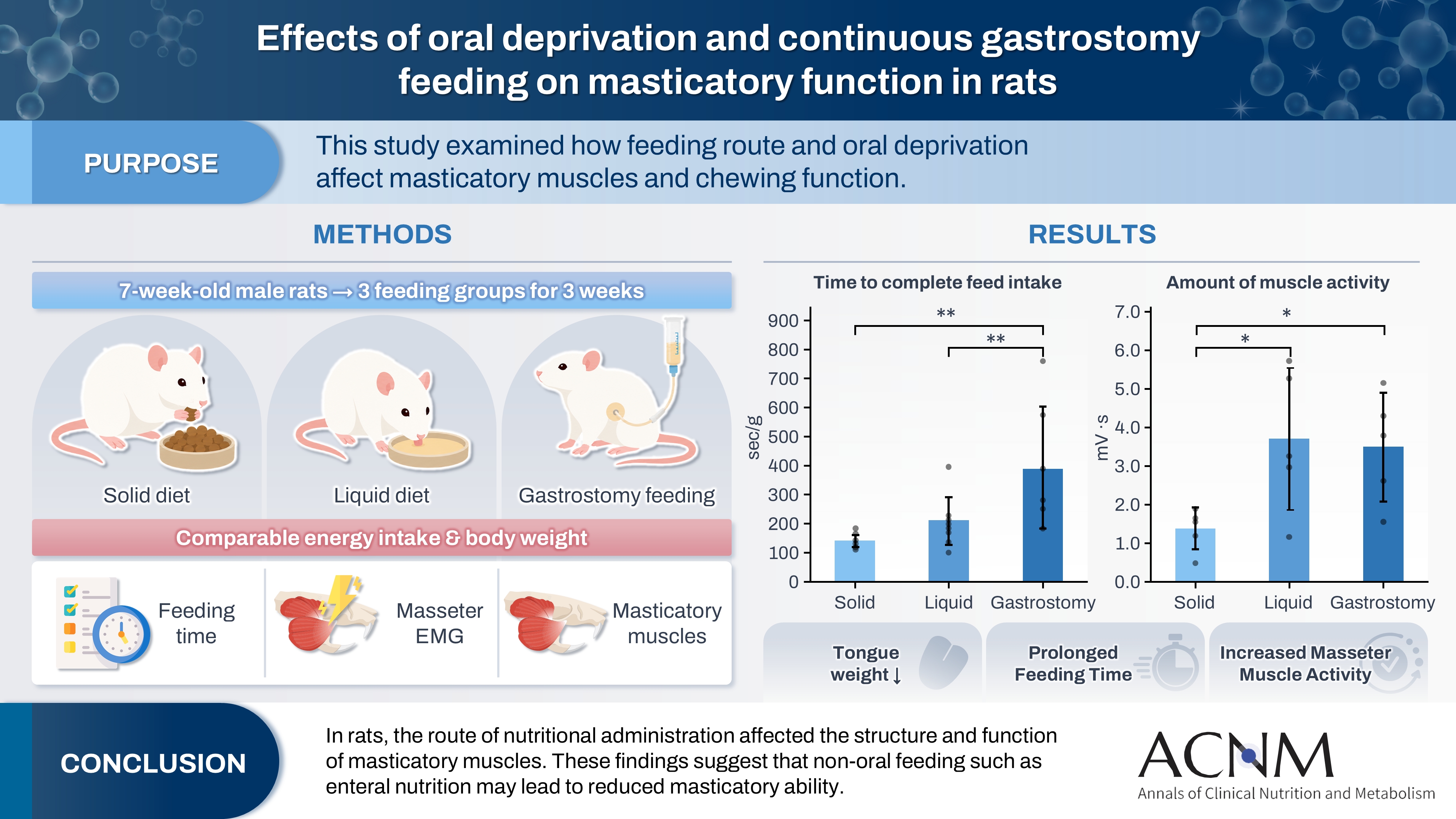
Tube feeding is frequently used in older adults and patients with dysphagia. However, when oral intake cannot be resumed, masticatory function may decline. Eating provides nutrition and helps maintain oral function, but the effects of different nutritional routes on masticatory muscles remain unclear. This study investigated the effects of a feeding model that combined differences in feeding route, diet form, and oral deprivation on masticatory-related muscles and masticatory function.
Methods
Seven-week-old male Sprague–Dawley rats were assigned to receive a solid diet (solid group), a liquid diet (liquid group), or continuous gastric feeding via gastrostomy (gastrostomy group) for 3 weeks. The time required to complete feed intake, masseter electromyographic activity, and masticatory muscles weights were evaluated.
Results
Energy intake and body weight changes did not differ significantly among the groups during the feeding period. Masseter muscle weight was significantly lower in the liquid group than in the other groups, whereas temporalis muscle weight tended to be higher in the solid group. The time required to complete feed intake was significantly longer in the gastrostomy group (389.7±210.4 sec/g) than in the solid and liquid groups (140.0±21.4 and 207.8±82.2 sec/g, respectively; P<0.01). When solid food was consumed after the 3-week feeding period, muscle activity during eating was higher in both the liquid and gastrostomy groups than in the solid group.
Conclusion
Feeding models involving oral deprivation or gastrostomy feeding altered masticatory-related muscle characteristics and chewing performance in rats. Reduced feeding activity may contribute to impaired chewing and changes in tongue weight.
|
 E-submission
 KSPEN
KSPEN KSSMN
KSSMN ASSMN
ASSMN JSSMN
JSSMN