-
Association of early parenteral energy provision with serum phosphorus decline and phosphorus-based refeeding syndrome in critically ill patients with liver cirrhosis: a Korean retrospective observational study
-
Jee Young Lee
 , Yeo Kon Kye, Kwang Il Seo, Kyung Won Seo, Sooyong Lee, Jesang Yu , Yeo Kon Kye, Kwang Il Seo, Kyung Won Seo, Sooyong Lee, Jesang Yu
-
Ann Clin Nutr Metab 2026;18(2):162-172. Published online July 31, 2026
-
DOI: https://doi.org/10.15747/ACNM.26.0055
-
-
 Graphical Abstract Graphical Abstract
 Abstract Abstract
 PDF PDF
 - Purpose
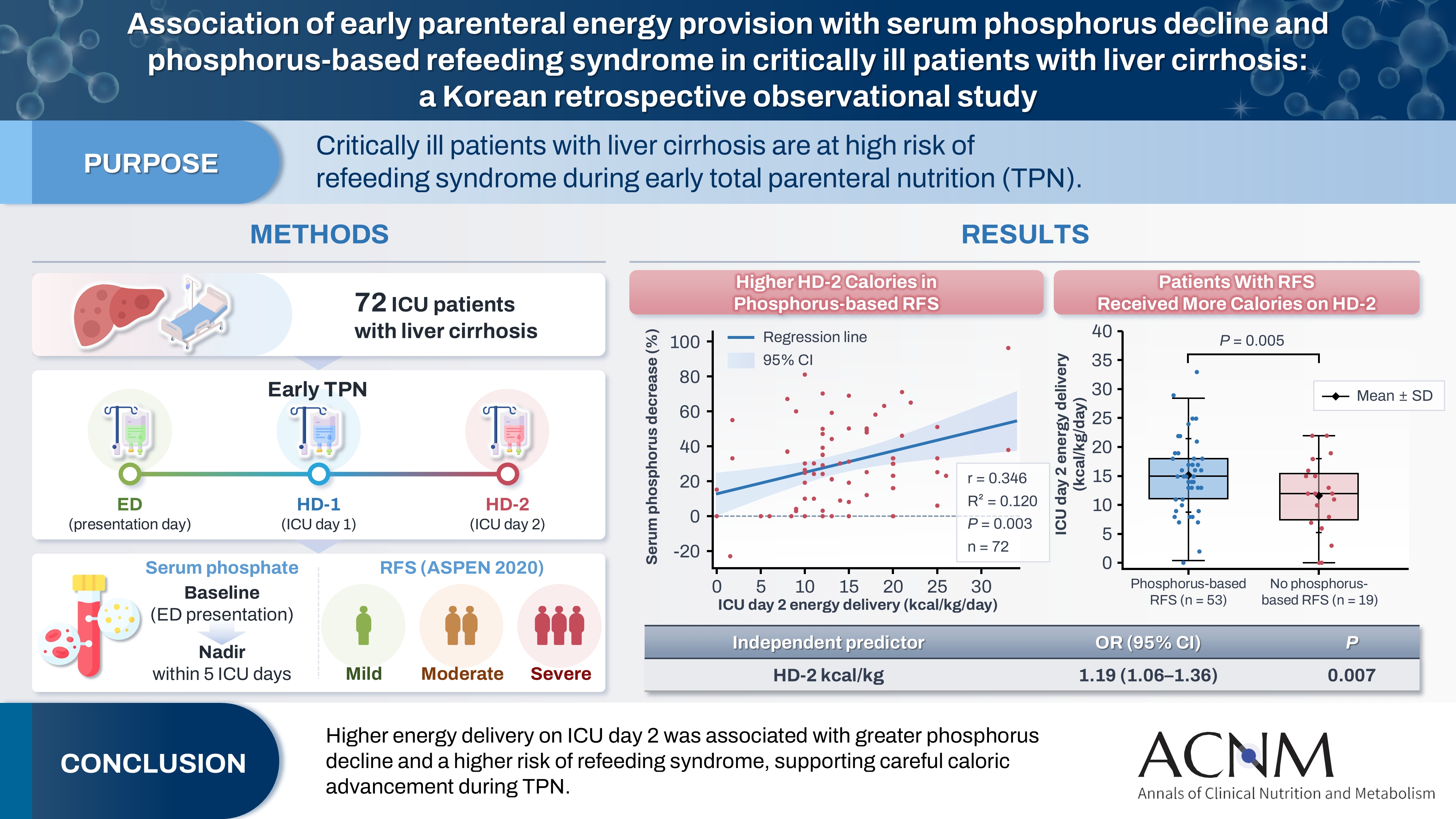
Critically ill patients with liver cirrhosis are vulnerable to malnutrition and refeeding-related electrolyte disturbances, particularly with rapid caloric advancement. As hypophosphatemia is a key feature of refeeding syndrome (RFS) and phosphorus homeostasis may be impaired in cirrhosis, the association of early parenteral energy provision with serum phosphorus decline and RFS was evaluated in cirrhotic ICU patients.
Methods
This retrospective study included 72 adults with liver cirrhosis admitted to a tertiary intensive care unit (ICU) between January 2021 and August 2024. Parenteral energy intake was assessed at emergency department (ED) and on ICU days 1 and 2. Serum phosphorus reduction was defined as the percentage decrease from baseline to the nadir within 5 ICU days. Phosphorus-based RFS was defined per the 2020 ASPEN consensus as a ≥10% phosphorus decrease after reinitiating or increasing energy provision, graded as mild, moderate, or severe.
Results
Phosphorus-based RFS occurred in 53 patients (73.6%), including severe RFS in 35 (48.6%). ICU day 2 caloric intake per body weight correlated with phosphorus reduction (r=0.346, P=0.003) and was independently associated with greater decline (P=0.011) and with meeting RFS criteria (odds ratio, 1.19; 95% CI, 1.06–1.36; P=0.007), along with ED glucose load (P=0.001). ROC analysis showed modest discrimination (AUC 0.7061; cutoff, 10.92 kcal/kg/day).
Conclusion
Higher caloric delivery on ICU day 2 was associated with greater phosphorus decline and RFS in cirrhotic ICU patients. These exploratory associations do not establish causality, and the cutoff requires external validation. Monitoring caloric delivery and serial electrolytes may support safer parenteral nutrition.
|
 E-submission
 KSPEN
KSPEN KSSMN
KSSMN ASSMN
ASSMN JSSMN
JSSMN