
 E-submission
 KSPEN
KSPEN KSSMN
KSSMN ASSMN
ASSMN JSSMN
JSSMNIndexed in:
Scopus, KCI, KoreaMed
Scopus, KCI, KoreaMed

Search
- Page Path
- HOME > Search
Original Article
- Effects of oral deprivation and continuous gastrostomy feeding on masticatory function in rats
-
Airi Honjo
 , Ippei Yamaoka
 - Ann Clin Nutr Metab 2026;18(2):173-180. Published online July 31, 2026
- DOI: https://doi.org/10.15747/ACNM.26.0051
-
 Graphical Abstract
 Abstract
 PDF
PDF - Purpose
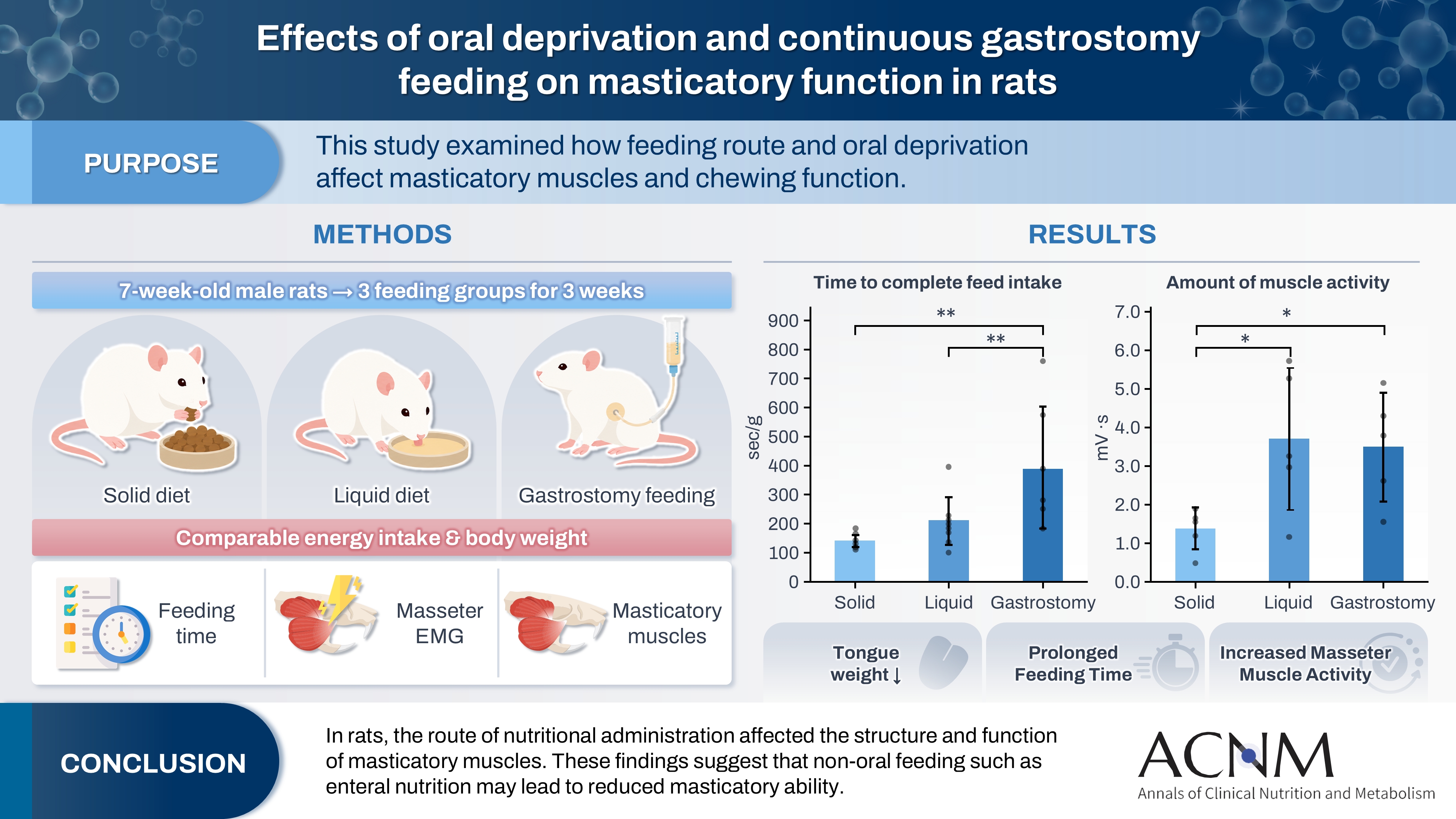
Tube feeding is frequently used in older adults and patients with dysphagia. However, when oral intake cannot be resumed, masticatory function may decline. Eating provides nutrition and helps maintain oral function, but the effects of different nutritional routes on masticatory muscles remain unclear. This study investigated the effects of a feeding model that combined differences in feeding route, diet form, and oral deprivation on masticatory-related muscles and masticatory function.
Methods
Seven-week-old male Sprague–Dawley rats were assigned to receive a solid diet (solid group), a liquid diet (liquid group), or continuous gastric feeding via gastrostomy (gastrostomy group) for 3 weeks. The time required to complete feed intake, masseter electromyographic activity, and masticatory muscles weights were evaluated.
Results
Energy intake and body weight changes did not differ significantly among the groups during the feeding period. Masseter muscle weight was significantly lower in the liquid group than in the other groups, whereas temporalis muscle weight tended to be higher in the solid group. The time required to complete feed intake was significantly longer in the gastrostomy group (389.7±210.4 sec/g) than in the solid and liquid groups (140.0±21.4 and 207.8±82.2 sec/g, respectively; P<0.01). When solid food was consumed after the 3-week feeding period, muscle activity during eating was higher in both the liquid and gastrostomy groups than in the solid group.
Conclusion
Feeding models involving oral deprivation or gastrostomy feeding altered masticatory-related muscle characteristics and chewing performance in rats. Reduced feeding activity may contribute to impaired chewing and changes in tongue weight.
- 1,012 View
- 13 Download

Reviews
- Bedside support for neurologically impaired patients via nutritional evaluations, swallowing function assessments, and gastrointestinal function tests: a narrative review
-
Daisuke Masui, Naoki Hashizume, Yoshinori Koga, Hiroto Eto, Hiroki Yoshida, Shotaro Taki, Takato Aikoh, Shiori Tsuruhisa, Tomohiro Kurahachi, Naruki Higashidate, Tatsuru Kaji
- Ann Clin Nutr Metab 2026;18(1):10-17. Published online March 30, 2026
- DOI: https://doi.org/10.15747/ACNM.25.0018
-
Abstract
PDF
- Purpose
Neurologically impaired patients often experience complex challenges in respiratory and nutritional management that may necessitate surgical intervention. Furthermore, some patients admitted to specialized facilities for neurologically impaired individuals do not receive adequate postoperative follow-up after being transferred. Kurume University Hospital has established a system of continuous routine rounds at such facilities. This review aims to describe the rationale, methods, and outcomes of multidisciplinary bedside support, with particular emphasis on nutritional evaluation, swallowing function assessment, and gastrointestinal function testing.
Current concept
Routine collaboration between pediatric surgeons and facility-based pediatricians enables continuous perioperative management. Preoperatively, patient background, nutritional status, and family preferences are recorded through structured communication and shared decision-making tools, such as the Ottawa Personal Decision Guide. During hospitalization, multidisciplinary evaluations include bioelectrical impedance analysis for nutritional assessment, endoscopic and pH impedance testing for swallowing function, and multichannel intraluminal impedance monitoring for gastroesophageal reflux. Postoperatively, periodic facility rounds ensure ongoing evaluation, with repeated assessments guiding nutritional optimization, early complication detection, and timely surgical consultation. This approach provides families and healthcare teams with detailed information on functional outcomes, strengthens trust, and enhances continuity of care. Sustained bedside engagement at facilities for neurologically impaired patients improves pre- and postoperative monitoring, promotes seamless collaboration between institutions, and ensures individualized evaluation of nutrition, swallowing, and gastrointestinal function.
Conclusion
By providing actionable data to families and multidisciplinary teams, this model strengthens shared decision-making and supports long-term outcomes. The system may serve as a framework for integrated perioperative care in similar high-risk patient populations.
- 1,452 View
- 33 Download
- Dysphagia and quality of life: a narrative review
-
Jung Mi Song

- Ann Clin Nutr Metab 2024;16(2):43-48. Published online August 1, 2024
- DOI: https://doi.org/10.15747/ACNM.2024.16.2.43
-
Abstract
PDF
- Purpose: Dysphagia is a chronic health condition that causes impairment of eating and drinking functions. It occurs in various diseases such as stroke, neurodegenerative disease, brain tumor, and head and neck cancer, and can also occur during the normal aging process.
Current concept: As patients experience symptoms of dysphagia, they no longer feel the pleasure of eating, depression and anxiety increase, and self-esteem decreases. Prolonged loss of appetite can lead to malnutrition, which can lead to death due to serious complications such as aspiration pneumonia and airway obstruction. Dysphagia reduces quality of life by affecting basic activities of daily living, limitations in social life, nutritional deficiencies, and mood disorders.
Conclusion: Accordingly, I plan to conduct a literature review on the quality of life of patients with dysphagia. First, to determine the relationship between quality of life and sociodemographic, physical health, and mental health characteristics of patients with dysphagia. I also aim to review quality of life measurement tools and intervention programs for patients with dysphagia. -
Citations
Citations to this article as recorded by
- Nursing interventions including psychological support and quality of life determinants in patients with dysphagia following stroke
Aihua Liu, Xuehong Liu, Ping Zhou
Journal of Research in Medical Sciences.2026;[Epub] CrossRef - Incidence and Risk Factors of Dysphagia After Cardiac Surgery: A Scoping Review
Christos Kourek, Vania Labropoulou, Emilia Michou, Stavros Dimopoulos
Journal of Clinical Medicine.2025; 14(12): 4279. CrossRef - Psychometric Properties of the Spanish Version of the Swallowing Quality of Life Questionnaire in Fibromyalgia Patients
Irene Calles-Plata, Araceli Ortiz-Rubio, Laura Pérez-Gisbert, Irene Torres-Sánchez, Andrés Calvache Mateo, Marie Valenza, Alejandro Heredia-Ciuró
Healthcare.2025; 13(22): 2948. CrossRef - Association Between Swallowing Dysfunction and Multidimensional Quality of Life Among Community-Dwelling Healthy Korean Older Adults: A Pilot Cross-Sectional Study
Hyun-Ah Jang, Jun-Seon Choi
Healthcare.2025; 13(22): 2964. CrossRef
- Nursing interventions including psychological support and quality of life determinants in patients with dysphagia following stroke
- 27,862 View
- 567 Download
- 4 Crossref
 First
First Prev
Prev


