
 E-submission
 KSPEN
KSPEN KSSMN
KSSMN ASSMN
ASSMN JSSMN
JSSMNIndexed in:
Scopus, KCI, KoreaMed
Scopus, KCI, KoreaMed

Search
- Page Path
- HOME > Search
Original Article
- Association of soy oil-based lipid injectable emulsion with early body weight loss after minimally invasive esophagectomy in Japan: a retrospective cohort study
-
Tomonori Narita
 , Kazuhiko Fukatsu, Kenichi Kono, Satoshi Murakoshi, Reo Inoue, Midori Noguchi, Nana Matsumoto, Shoh Yajima, Koichi Yagi, Yoshifumi Baba
 - Ann Clin Nutr Metab 2026;18(1):34-43. Published online March 30, 2026
- DOI: https://doi.org/10.15747/ACNM.25.0030
-
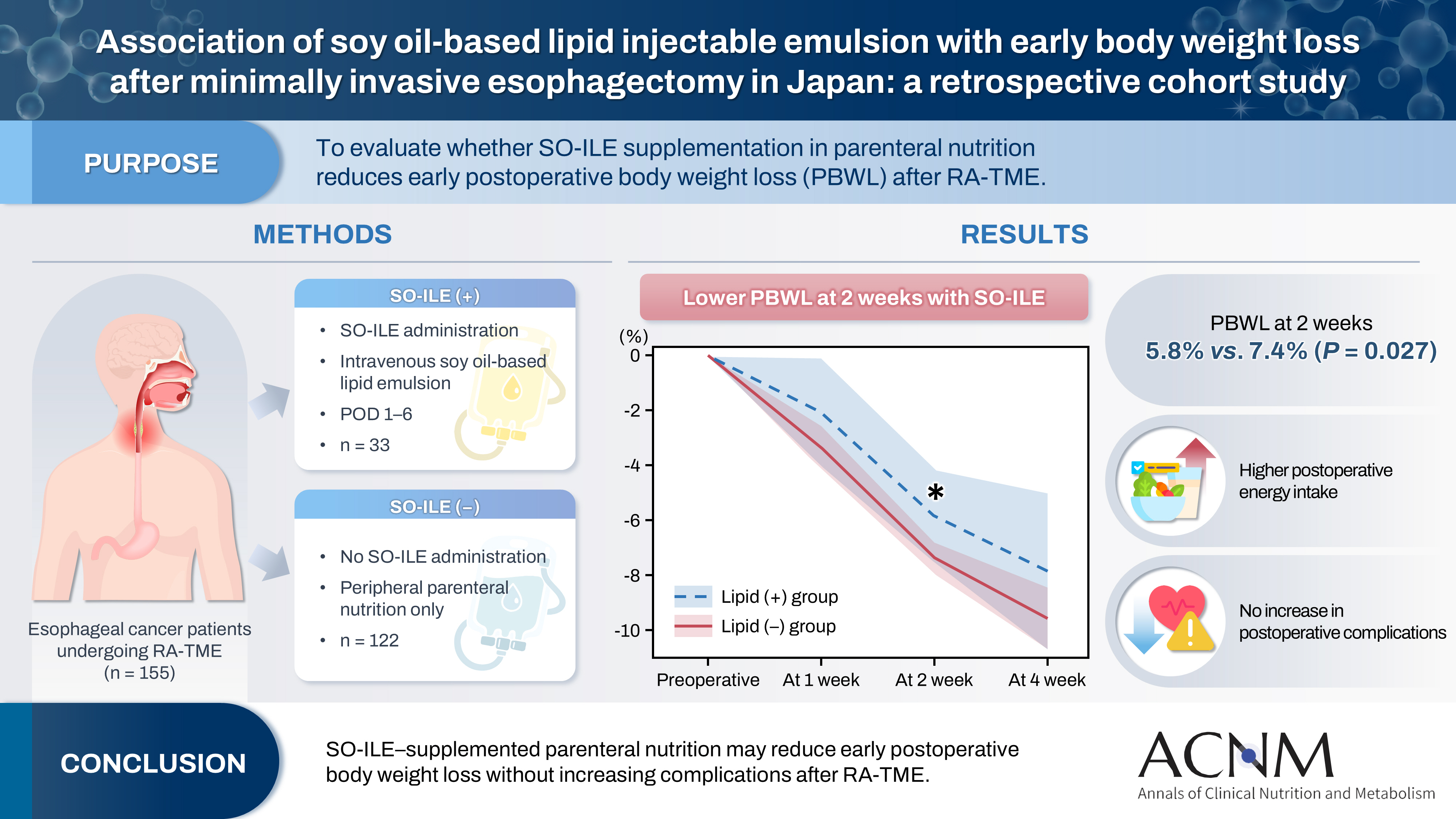
 Graphical Abstract
 Abstract
 PDF
PDF Supplementary Material
 - Purpose
Postoperative body weight loss (PBWL) is associated with poor long-term outcomes following esophagectomy for esophageal cancer, underscoring the critical importance of perioperative nutritional management. Although minimally invasive procedures, such as robot-assisted radical transmediastinal esophagectomy (RA-TME), have become increasingly prevalent, perioperative nutritional strategies have received comparatively limited attention. This study evaluated the impact of soy oil-based injectable lipid emulsion (SO-ILE) on PBWL in patients undergoing RA-TME.
Methods
We retrospectively analyzed 155 patients who underwent RA-TME for esophageal or esophagogastric junction cancer at our hospital between 2011 and 2022. Patients were divided into two groups: the lipid (+) group (n=33), which received SO-ILE between postoperative days 1 and 6, and the lipid (–) group (n=122), which did not receive SO-ILE. Oral or enteral nutrition was withheld until postoperative day 6. Nutrient intake, postoperative outcomes, and nutritional status were compared between the two groups.
Results
Patient backgrounds, surgical outcomes, and postoperative complication rates were similar between the two groups. However, patients in the lipid (+) group received significantly greater total energy and nutrient intake. PBWL at 2 weeks after surgery was significantly lower in the lipid (+) group than in the lipid (–) group (5.8% vs. 7.4%; P=0.027). Univariate analysis showed that absence of SO-ILE administration was the only significant risk factor for PBWL greater than 5% at 2 weeks after RA-TME (P=0.038).
Conclusion
SO-ILE may have the potential to mitigate early PBWL after RA-TME.
- 2,384 View
- 24 Download

Review Article
- Lipids: Functional Effects and Clinical Application in Parenteral Nutrition
- Soo Jin Yang
- Surg Metab Nutr 2016;7(1):1-6. Published online June 30, 2016
- DOI: https://doi.org/10.18858/smn.2016.7.1.1
-
Abstract
PDF
Lipids are structural components of cellular membrane and functional components exerting an important role in different metabolic pathways through regulation of cell signaling and metabolic homeostasis. Although the human body can synthesize some fatty acids, essential fatty acids (EFA) should be exogenously provided. Parenteral nutrition (PN) can be utilized to provide EFA for patients without normal gastrointestinal functions and those at risk of malnutrition. Parenteral lipids provide more energy-dense nutrition in a reduced volume and prevent EFA deficiency. However, prolonged PN with lipid emulsions is associated with metabolic complications including PN-associated liver disease. Currently available parenteral lipid emulsions provide various combinations of soybean oil, fish oil, olive oil and medium-chain triglycerides. The effects of parenteral lipid emulsions on the lipid nutrition status and PN-associated complications vary depending on the type and dosages of main oil sources used in parenteral lipid solutions. Therefore, understanding the composition, metabolism, and functional effects of lipids can be helpful in considering their clinical applications in PN.
- 1,769 View
- 3 Download
 First
First Prev
Prev


