
 E-submission
 KSPEN
KSPEN KSSMN
KSSMN ASSMN
ASSMN JSSMN
JSSMNIndexed in:
Scopus, KCI, KoreaMed
Scopus, KCI, KoreaMed

Search
- Page Path
- HOME > Search
Original Articles
- Postoperative nausea and vomiting after emergent abdominal surgery in trauma patients in Korea: a multicenter retrospective observational study
-
Doo-Hun Kim
 , Hoonsung Park, Heejin Kim, Jihyeon Ahn, Mina Choi, Dae-Sang Lee, Tae Hwa Hong, Hang Joo Cho, Maru Kim
 - Ann Clin Nutr Metab 2026;18(2):138-144. Published online July 31, 2026
- DOI: https://doi.org/10.15747/ACNM.26.0044
-
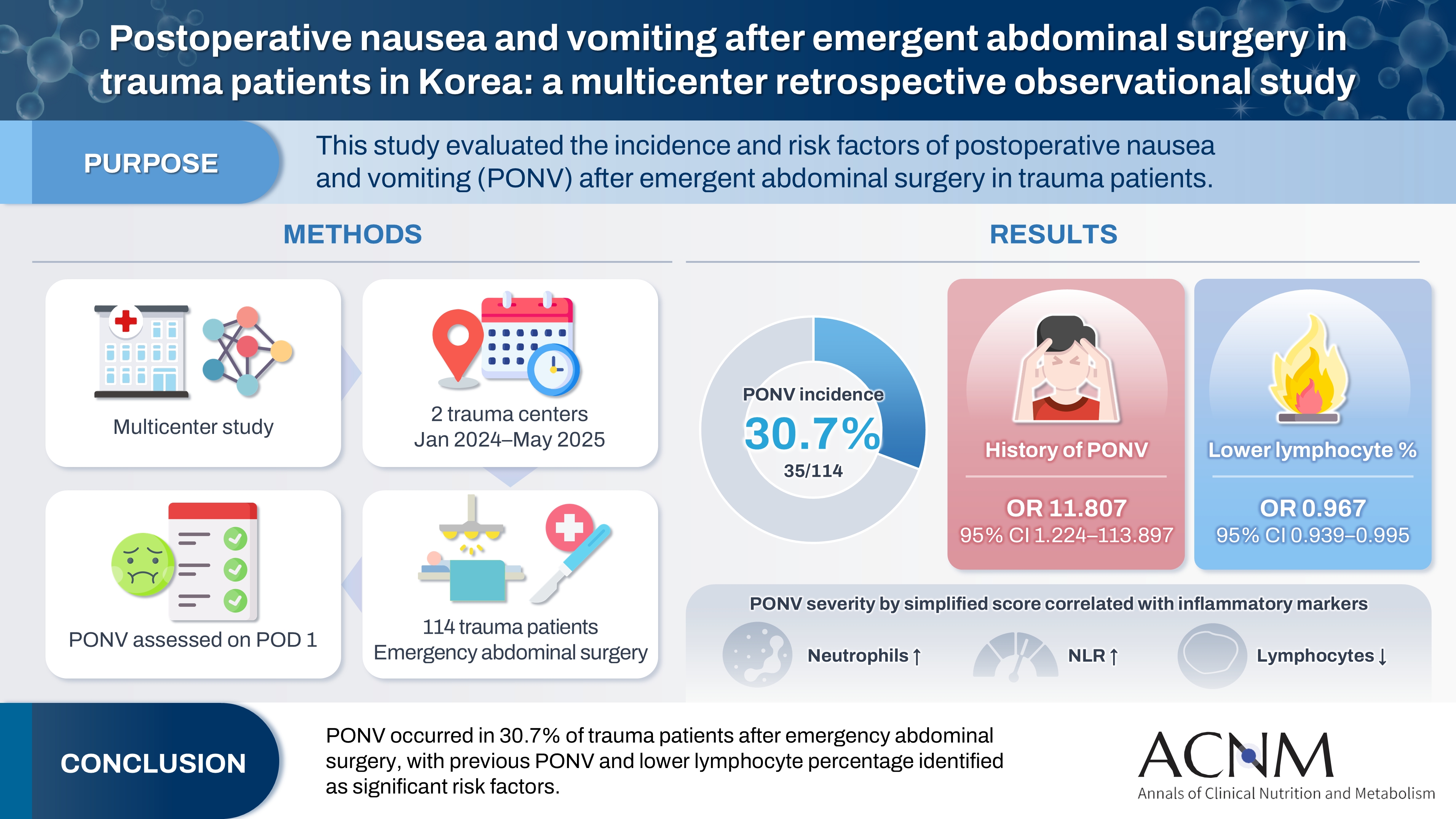
 Graphical Abstract
 Abstract
 PDF
PDF - Purpose
The present study aimed to assess the incidence and risk factors of postoperative nausea and vomiting (PONV) after emergency abdominal surgery in trauma patients.
Methods
This retrospective observational study included trauma patients who underwent emergency abdominal surgery at two trauma centers between January 2024 and May 2025. Medical records were reviewed according to the occurrence of PONV.
Results
A total of 114 patients were included in the analysis, of whom 35 patients (30.7%) developed PONV. Patients with a history of PONV had a higher incidence of PONV than those without such a history (80% vs. 28.4%; P=0.030). The lymphocyte percentage was lower in the PONV group (27.8% vs. 20.0%; P=0.023). In binary logistic regression analysis, previous PONV (B=2.469, P=0.033; odds ratio [OR], 11.807; 95% confidence interval [CI], 1.224–113.897) and lymphocyte percentage (B=−0.034, P=0.021; OR, 0.967; 95% CI, 0.939–0.995) were significant risk factors. PONV severity was also associated with a higher segmented neutrophil percentage, a higher neutrophil-to-lymphocyte ratio, and a lower lymphocyte percentage.
Conclusion
The incidence of PONV was 30.7%. Previous PONV and a lower lymphocyte percentage were identified as risk factors for PONV after emergency abdominal surgery in trauma patients. Further studies are needed to develop strategies for reducing PONV in this population.
- 880 View
- 23 Download

- Preoperative consumption of a carbohydrate drink before laparoscopic cholecystectomy is safe and beneficial in Korea: a non-randomized controlled study
-
Yoo Jin Choi, Yoonhyeong Byun, Seong Mi Yang, Ho-Jin Lee, Hongbeom Kim
- Ann Clin Nutr Metab 2023;15(1):15-21. Published online April 1, 2023
- DOI: https://doi.org/10.15747/ACNM.2023.15.1.15
-
Abstract
PDF
 Supplementary Material
 - Purpose: Overnight fasting prior to elective surgery is the traditional way of avoiding the risk of aspiration during anesthesia induction. However, it causes mental and metabolic stress to patients. Therefore, we investigated the safety and potential benefits of the preoperative consumption of a carbohydrate drink.
Methods: This was a single-center prospective, nonrandomized study with questionnaire. Patients scheduled for elective laparoscopic cholecystectomy were included. There was no restriction on age, underlying diseases, and biliary drainage prior to surgery. They were preoperatively given either a carbohydrate drink or were instructed to fast from midnight before surgery. Perioperative emotional status was measured using the visual analog scale.
Results: The 132 patients completed the questionnaire, with 68 receiving the carbohydrate drink and 64 following nil per oral after-midnight instruction. There were no postoperative complications related to preoperative drink consumption or the cholecystectomy procedure itself in both groups. There were no significant differences in all the assessed feelings postoperatively except that preoperative discomforts, such as hunger and thirst, were significantly more alleviated in the group of preoperative consumption of a carbohydrate drink.
Conclusion: Preoperative consumption of a carbohydrate drink was found to be safe and effective in alleviating preoperative discomfort in elective surgery patients, including older patients and those with underlying comorbidities, who were at greater risk for aspiration. Therefore, we recommend considering preoperative drink consumption as an alternative to traditional overnight fasting in elective surgery patients. -
Citations
Citations to this article as recorded by
- MODERN CONCEPT OF POSTOPERATIVE ANALGESIA IN PATIENTS UNDERGOING URGENT LAPAROSCOPIC CHOLECYSTECTOMY
O. PYLYPENKO, O. KRAVETS
Pain anesthesia and intensive care.2024; (4(109)): 55. CrossRef
- MODERN CONCEPT OF POSTOPERATIVE ANALGESIA IN PATIENTS UNDERGOING URGENT LAPAROSCOPIC CHOLECYSTECTOMY
- 12,934 View
- 105 Download
- 1 Crossref
 First
First Prev
Prev


