
 E-submission
 KSPEN
KSPEN KSSMN
KSSMN ASSMN
ASSMN JSSMN
JSSMNIndexed in:
Scopus, KCI, KoreaMed
Scopus, KCI, KoreaMed

Articles
- Page Path
- HOME > Ann Clin Nutr Metab > Volume 18(2); 2026 > Article
- Original Article Association between dysphagia diet intake at acute-care discharge and activities of daily living at discharge from a convalescent rehabilitation ward: a single-center retrospective cohort study in Japan
-
Mayu Awata1
 , Kotomi Sakai2, Nobuo Sakata2,3
 -
Annals of Clinical Nutrition and Metabolism 2026;18(2):154-161.
DOI: https://doi.org/10.15747/ACNM.26.0048
Published online: July 31, 2026
1Department of Nutrition, Setagaya Memorial Hospital, Tokyo, Japan
2Department of Research, Heisei Medical Welfare Group Research Institute, Tokyo, Japan
3Department of Health Services Research, Faculty of Medicine, University of Tsukuba, Tsukuba, Japan
- Corresponding author: Nobuo Sakata, email: sakata.nobuo@hmw.gr.jp
• Received: March 9, 2026 • Revised: May 2, 2026 • Accepted: May 27, 2026
© 2026 The Korean Society of Surgical Metabolism and Nutrition · The Korean Society for Parenteral and Enteral Nutrition · Asian Society of Surgical Metabolism and Nutrition
This is an Open Access article distributed under the terms of the Creative Commons Attribution Non-Commercial License (http://creativecommons.org/licenses/by-nc/4.0), which permits unrestricted non-commercial use, distribution, and reproduction in any medium, provided the original work is properly cited.
- 1,438 Views
- 26 Download


Abstract
-
Purpose This study examined whether intake of a dysphagia diet at acute-care discharge was associated with activities of daily living (ADL) at discharge from a convalescent rehabilitation ward among older orthopedic patients.
-
Methods This retrospective study included patients aged ≥65 years admitted to a convalescent rehabilitation ward between January 2019 and April 2024. Patients with pharyngeal or esophageal dysphagia were excluded. The exposure was dysphagia diet intake at acute-care discharge. Motor Functional Independence Measure (FIM) score at rehabilitation discharge was analyzed using multivariable linear regression adjusted for age, admission motor FIM score, and cognitive function. Nutritional indicators at rehabilitation admission were compared between groups, and reasons for diet modification during acute care were summarized.
-
Results Among 300 patients, 74 (24.7%) received a dysphagia diet at acute-care discharge. At rehabilitation admission, the dysphagia diet group had poorer nutritional and muscle-related status than the regular diet group. After adjustment, dysphagia diet intake was associated with a 3.41-point lower motor FIM score at discharge. Ill-fitting dentures were the most common reason for diet modification (33.8%); however, the reason was unclear in 27.0% of cases.
-
Conclusion Among older orthopedic patients without pharyngeal or esophageal dysphagia, intake of a dysphagia diet at acute-care discharge was associated with lower ADL at discharge from a convalescent rehabilitation ward after adjustment for selected covariates. This finding should be interpreted as a clinical risk marker rather than evidence that clinically indicated dysphagia diets should be avoided. Early reassessment of diet modifications and correction of reversible oral conditions may help improve rehabilitation care.
Graphical abstract
Introduction
As the global population ages, oral and nutritional health in older adults have become important public health issues [1]. According to the World Health Organization, compromised oral health, whether due to disease or other factors, can adversely affect overall health. Older adults are also at high risk of malnutrition and oral problems, underscoring the need for integrated oral and nutritional management [2]. A dysphagia diet is designed for individuals with swallowing difficulties caused by impairments in the oral cavity, pharynx, or esophagus. Such diets typically involve modifications in texture and cohesiveness to support safe and efficient swallowing [3]. In a study of older inpatients in an acute-care hospital, approximately 38% required a dysphagia diet [4]. Although dysphagia diets may improve swallowing safety, they often have lower nutritional content because water is added and may be visually less appealing, which can reduce appetite and increase the risk of malnutrition [5,6].
In rehabilitation inpatients, malnutrition is associated with adverse outcomes, including declines in activities of daily living (ADL) [7]. Because dysphagia diets may exacerbate malnutrition, nutritional management is an important component of care for patients receiving such diets [8]. Healthcare professionals should also strive to create conditions that allow patients to maintain oral intake without relying on dysphagia diets. However, many patients in acute care remain hospitalized without appropriate oral management, even when they have oral problems [9]. Consequently, some patients receive dysphagia diets despite lacking absolute indications, such as pharyngeal dysphagia, that would limit their ability to consume regular food safely.
The effect of dysphagia diet intake at acute-care discharge on subsequent ADL during convalescent rehabilitation remains unclear among patients who lack absolute indications, such as pharyngeal dysphagia.
This study aimed to examine the association between dysphagia diet intake at acute-care discharge and ADL at discharge among convalescent rehabilitation patients, excluding those with absolute indications for dysphagia diets during the acute-care hospital stay, such as pharyngeal dysphagia. We also investigated why patients received a dysphagia diet during the acute-care hospital stay despite lacking an absolute indication. Our findings may inform nutritional strategies, ADL improvement at discharge, and continuity of care across the transition from acute care to rehabilitation.
Methods
This retrospective cohort study included patients aged ≥65 years who were admitted to a convalescent rehabilitation ward for musculoskeletal disorders between January 2019 and April 2024. We focused on musculoskeletal disorders because recovery in these patients is considered more strongly influenced by nutritional status than recovery in patients with cerebrovascular or neuromuscular diseases, which depends primarily on neurological function. The exclusion criteria were inability to obtain nutrition exclusively through oral intake at admission, admission motor Functional Independence Measure (FIM) score ≥65, Mini-Mental State Examination (MMSE) score <20 at admission, diagnosis of depression at admission, activity restrictions due to medical management, pharyngeal or esophageal dysphagia, dysphagia diets prescribed for gastrointestinal disorders, transfer or death due to clinical deterioration or other complications, and length of stay ≤14 days or ≥91 days [10]. Patients with a motor FIM score ≥65 at admission were excluded to account for potential ceiling effects [11]. Although some of these patients might still have poor nutritional status, their baseline functional independence was already high, which limited the ability to accurately assess the effect of dietary modifications on motor FIM score at rehabilitation discharge. MMSE score and depression status were included because of their substantial influence on motor FIM score at discharge. A key feature of the study design was the exclusion of patients with pharyngeal, esophageal, or gastrointestinal indications for a dysphagia diet.
The exposure was defined as intake of a dysphagia diet at discharge from the acute-care hospital. A dysphagia diet was classified as levels 2–4 of the 2021 Japanese Society of Dysphagia Rehabilitation Classification of Dysphagia Diets [12]. Levels 0 and 1, which generally require alternative nutrition, were excluded. Diet type at acute-care discharge was confirmed from the acute-care hospital discharge summary or, if undocumented, by direct telephone inquiry.
The primary outcome was the motor FIM score at discharge from the convalescent rehabilitation ward. The motor FIM score comprises 13 items covering self-care, sphincter control, transfers, and locomotion, each scored on a 7-point scale, with higher scores indicating greater independence [13]. FIM scores were determined by consensus among the attending physician, physical therapist, occupational therapist, speech-language pathologist, nurse, and care worker.
Other variables assessed at admission to the convalescent rehabilitation ward included acute-care hospital length of stay, age, sex, primary diagnosis, MMSE score, grip strength, skeletal muscle mass index (SMI), motor FIM score, body mass index (BMI), Mini Nutritional Assessment–Short Form (MNA-SF) score [14], and sarcopenia. SMI was measured in the supine position using bioelectrical impedance analysis (InBody S10, InBody Japan Inc.). Sarcopenia was diagnosed according to the 2019 Asian Working Group for Sarcopenia consensus criteria [15].
This study was approved by the Ethics Committee of the Heisei Medical Welfare Group Research Institute (Approval No. 2023-01). The committee waived the requirement for individual informed consent and approved an opt-out method, whereby study information was disclosed publicly and participants had the opportunity to decline participation.
Descriptive statistics were used to summarize the data. Continuous variables were expressed as medians with interquartile ranges (IQRs) because of their non-normal distribution. Categorical variables were presented as numbers and percentages. Missing data were handled using available-case analysis; patients were excluded only from analyses for which their data were missing. Patients were classified into dysphagia diet and regular diet groups according to diet type at acute-care hospital discharge. Group comparisons were performed using the Mann-Whitney U test for continuous variables and the Fisher exact test for categorical variables.
Multivariable linear regression analysis was performed to examine whether dysphagia diet intake at acute-care discharge was independently associated with motor FIM score at discharge. The dependent variable was motor FIM score at discharge, and the covariates—age, motor FIM score at admission, and MMSE score at admission—were selected based on a directed acyclic graph representing plausible causal relationships (Model 1) (Fig. 1). As sensitivity analyses for unmeasured baseline confounding, additional models (Models 2–4) were developed by progressively adjusting for MNA-SF score and handgrip strength. Multicollinearity was assessed using variance inflation factors (VIFs). All VIF values were below 5.0, indicating no evidence of serious multicollinearity. Descriptive comparisons of nutritional status at admission, reasons for dysphagia diet use during the acute-care hospital stay, and clinical course during the convalescent period were performed between groups. EZR (version 4.2.3; Jichi Medical University, Tochigi, Japan), a graphical user interface for R (The R Foundation for Statistical Computing, Vienna, Austria), was used for the analyses [16]. EZR is a modified version of R Commander with additional statistical functions commonly used in biostatistics. Two-sided P <0.05 was considered statistically significant.
Results
During the study period, 859 patients met the inclusion criteria. Of these, 559 were excluded based on the predefined criteria, leaving 300 patients (68 [22.7%] males and 232 [77.3%] females) for the final analysis (Fig. 2). The median age of the participants was 86.0 years (IQR, 81.0–89.0 years). The primary diagnoses were femoral fracture (n=163, 54.3%), thoracolumbar vertebral fracture (n=85, 28.3%), and other musculoskeletal disorders (n=52, 17.3%). Among the patients, 74 (24.7%) received a dysphagia diet at acute-care discharge, whereas 226 (75.3%) received a regular diet. The median acute-care hospital length of stay was 31.5 days (IQR, 23.8–41.3 days) in the dysphagia diet group and 28.0 days (IQR, 20.0–39.0 days) in the regular diet group. Table 1 presents the patient characteristics at admission to the convalescent rehabilitation ward.
At admission, participants in the dysphagia diet group had a significantly lower BMI (median, 19.01 kg/m2; IQR, 17.07–21.59 kg/m2) than those in the regular diet group (median, 20.55 kg/m2; IQR, 18.05–22.63 kg/m2; P=0.002), as well as a lower MNA-SF score (median: 4.0 [IQR, 3.0–6.0] vs. 5.0 [IQR, 4.0–7.0]; P=0.019). Handgrip strength was also lower in the dysphagia diet group (median, 14.20 kg; IQR, 12.20–18.80 kg) than in the regular diet group (median, 16.5 kg; IQR, 13.50–20.40 kg; P=0.019). Similarly, SMI was lower in the dysphagia diet group (median, 5.40 kg/m²; IQR, 4.75–6.10 kg/m2) than in the regular diet group (median, 5.70 kg/m²; IQR, 5.10–6.70 kg/m²; P=0.005). The prevalence of sarcopenia was higher in the dysphagia diet group (67.2%) than in the regular diet group (55.2%), although the difference was not statistically significant (P=0.089) (Table 2).
In univariable analyses, dysphagia diet intake at acute-care discharge was significantly associated with lower motor FIM scores at discharge (Table 3). In multivariable linear regression analysis, dysphagia diet intake at acute-care discharge remained associated with lower motor FIM scores at discharge from the convalescent rehabilitation ward after adjustment for age, motor FIM score at admission, and MMSE score (β, −3.41; 95% confidence interval [CI], −5.55 to −1.28; P=0.002) (Model 1). This association persisted in sensitivity analyses that further adjusted for MNA-SF score and handgrip strength (Models 2–4) (Table 4).
The most common reason for dysphagia diet intake at acute-care discharge was ill-fitting dentures (n=25, 33.8%), followed by unclear reasons (n=20, 27.0%), patient preference (n=12, 16.2%), non-dental intraoral problems (e.g., mucosal abnormalities) (n=11, 14.9%), and poor general condition (n=6, 8.1%). During the convalescent rehabilitation, nine of 25 patients (36.0%) who received a dysphagia diet because of ill-fitting dentures were able to transition to a regular diet after dental intervention. The remaining patients continued to have denture-related problems and were unable to resume a regular diet. Of the 11 patients with other intraoral problems, six (54.5%) transitioned to a regular diet during the convalescent period. Among the 20 patients for whom the reason for dysphagia diet provision was unclear, 18 (90.0%) resumed a regular diet within 1 week of admission, whereas the remaining two continued receiving a dysphagia diet because of personal preference.
Discussion
Among patients without absolute indications for a dysphagia diet, such as pharyngeal or esophageal dysphagia, dysphagia diet intake at acute-care discharge was significantly associated with lower motor FIM scores at discharge from the convalescent rehabilitation ward. These patients also had poorer nutritional status at admission to the convalescent rehabilitation ward than those receiving a regular diet. The most common reason for dysphagia diet provision was ill-fitting dentures. In 27.0% of cases, the rationale for dysphagia diet provision during the acute-care hospital stay was unclear. Many of these patients transitioned to a regular diet immediately after admission to rehabilitation, suggesting that some restrictive diets may have been implemented as a precautionary measure or may have been avoidable with comprehensive nutritional assessment, including assessment of oral health status. Although the adjusted difference in discharge motor FIM score was modest, even small differences in functional independence at discharge may affect subsequent care needs, rehabilitation planning, and long-term outcomes in older adults.
Our findings are consistent with the hypothesis that malnutrition may partly explain the association between dysphagia diet intake and reduced ADL at discharge. Malnutrition during acute hospitalization increases the risk of hospitalization-associated disability, defined as newly developed or worsened ADL impairment during hospitalization [17,18]. Previous studies in rehabilitation inpatients have reported associations between malnutrition and lower FIM scores at 21 days [19] and between low energy intake and poorer efficiency in motor FIM improvement [20]. Although nutritional status at admission to the convalescent rehabilitation ward was modeled as a mediator in the directed acyclic graph between the exposure and discharge FIM scores in our study, our findings are consistent with previous reports linking malnutrition to lower ADL among patients undergoing inpatient rehabilitation [7,19]. In the present study, dysphagia diets were generally lower in energy content than regular diets and were therefore considered the exposure variable rather than direct indicators of malnutrition. This study differs from previous studies because intake of a dysphagia diet, a potential contributor to malnutrition, was defined as the exposure rather than malnutrition indicators themselves. By excluding patients with pharyngeal or esophageal dysphagia, we focused on cases in which dysphagia diets might be avoidable through preventive or supportive measures, such as denture adjustment, potentially broadening opportunities for intervention. Several mechanisms may explain the association between dysphagia diets and lower motor FIM scores at discharge through malnutrition. These diets often have higher water content to soften food and improve bolus cohesion [5,6,8], resulting in lower nutrient density and larger intake volumes to meet energy needs, which can be challenging for older adults [21]. In addition, the reduced visual appeal of such diets may reduce appetite, further increasing the risk of malnutrition [5,8,22-25]. Dysphagia diets are a form of dietary restriction and should therefore be avoided when possible and carefully monitored when implemented. These recommendations are included in the hospital nutrition guidelines published by the European Society for Clinical Nutrition and Metabolism [21]. Malnutrition is also a known contributor to loss of muscle mass and strength [26]. In our study, patients receiving dysphagia diets had lower grip strength and SMI at admission to the convalescent rehabilitation ward, supporting the hypothesis that such diets may contribute to nutritional deterioration and subsequent functional decline.
Although the adjusted difference in discharge motor FIM score was modest (3.41 points) and did not reach the established minimal clinically important difference of 19–22 points for older orthopedic patients [27,28], even small differences in functional independence at discharge may affect subsequent care needs, rehabilitation planning, and long-term outcomes in older adults by increasing the level of assistance required.
This study has several limitations. First, dysphagia diet provision at acute-care discharge was determined from referral documents or verified by telephone, and the exact duration of dysphagia diet intake was unknown. Short durations may have had minimal effects, yet the observed negative association persisted even when such cases were included. Second, unmeasured confounding, such as overall physical condition during acute care, may have influenced the results. Nonetheless, given that many patients receiving dysphagia diets had oral problems, the association remains clinically plausible. These findings suggest that the observed association was not fully explained by measured nutritional and physical status. Nevertheless, residual confounding by pre-existing frailty, malnutrition, oral health status, and acute illness severity cannot be excluded. Furthermore, the lack of standardized swallowing and oral assessments during acute care limited our ability to determine the precise indications for diet modifications. Finally, the single-center design limits generalizability to other rehabilitation settings. In addition, excluding patients with an MMSE score <20 and depression limits the generalizability of our findings to broader clinical populations, as cognitive impairment and mood disorders are prevalent in rehabilitation settings. Because this was an observational study, the findings demonstrate an association rather than causation.
We do not imply that clinically necessary dysphagia diets for swallowing safety should be avoided; rather, their prescription in this specific population should serve as a trigger for comprehensive dental and nutritional reassessment.
This study showed that dysphagia diet intake during the acute-care hospital stay among older orthopedic patients was associated with poorer ADL at discharge from the convalescent rehabilitation ward. This association may reflect dysphagia diets prompted by modifiable factors, such as poor oral health, or by other transient clinical factors that do not require long-term dietary restriction. Therefore, prescription of a dysphagia diet in this population should be interpreted as a marker of underlying, often modifiable vulnerability that warrants comprehensive assessment. Prospective studies are needed to determine whether proactive oral care and systematic nutritional assessment can prevent potentially avoidable dietary restrictions and improve ADL at discharge in older acute-care patients. Accordingly, addressing underlying causes through comprehensive assessment rather than relying solely on dietary modification is essential for improving ADL at discharge.
Authors’ contribution
Conceptualization: MA, KS, NS. Data curation: MA. Formal analysis: MA, KS. Investigation: MA. Methodology: MA, KS. Supervision: NS. Writing–original draft: MA. Writing–review & editing: KS, NS. All authors read and approved the final manuscript.
Conflict of interest
The authors of this manuscript have no conflicts of interest to disclose.
Funding
None.
Data availability
The data that support the findings of this study are available from the corresponding author upon reasonable request but are not publicly available because of privacy and ethical restrictions.
Acknowledgments
None.
Supplementary materials
None.
Fig. 1.
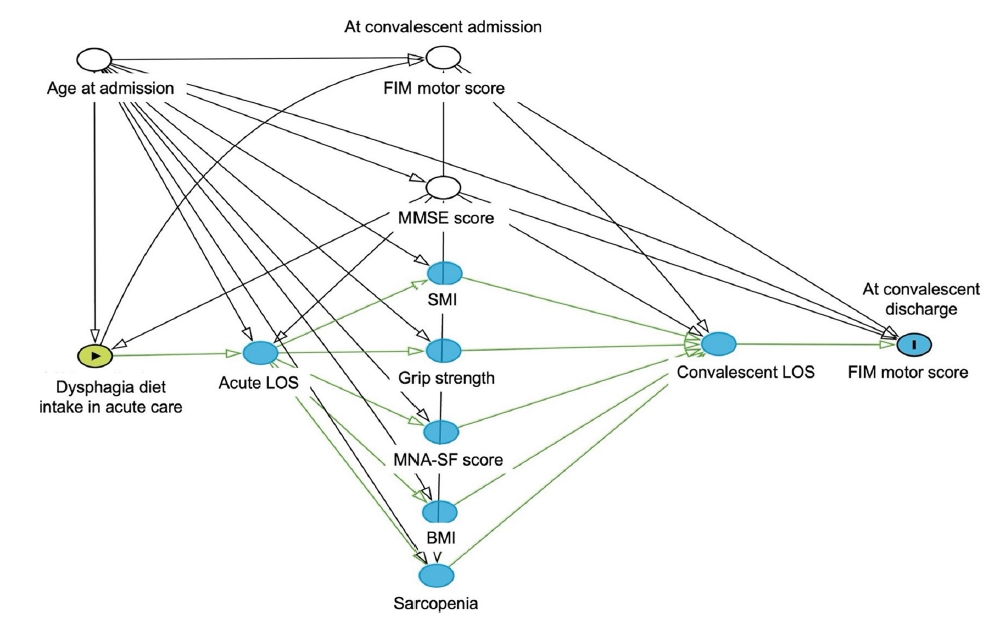
Directed acyclic graph illustrating the presumed relationships among acute-care dysphagia diet intake, baseline characteristics, nutritional status, and functional outcome at discharge. FIM, Functional Independence Measure; MMSE, Mini-Mental State Examination; SMI, skeletal muscle mass index; MNA-SF, Mini Nutritional Assessment–Short Form; BMI, body mass index; LOS, length of stay.
Fig. 2.
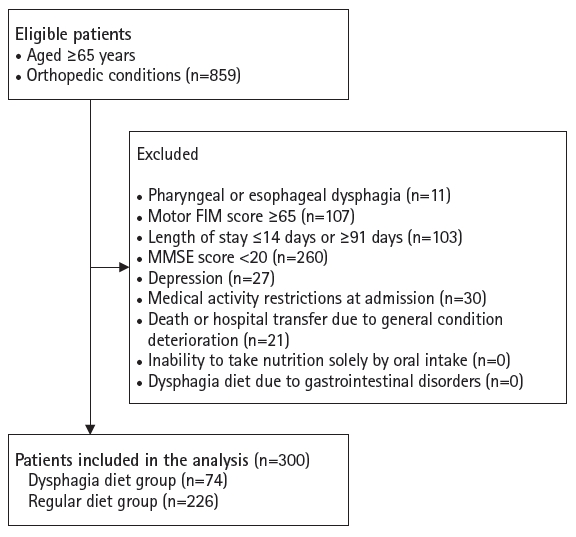
Flowchart of the patient selection process. A total of 859 eligible patients aged ≥65 years with orthopedic conditions were screened. After applying the exclusion criteria, 300 patients were included in the final analysis (74 in the dysphagia diet group and 226 in the regular diet group).

Table 1.
Patient characteristics at admission to the convalescent ward
Table 2.
Comparison of nutritional indices between groups at admission to the convalescent ward
Values are presented as median (interquartile range) or number (%). Data availability differed across variables due to missing data: BMI (n=299), MNA-SF (n=300), grip strength (n=284), SMI (n=267), sarcopenia (n=270).
BMI, body mass index; MNA-SF, Mini Nutritional Assessment–Short Form; SMI, skeletal muscle mass index.
P<0.05 was considered statistically significant.
Table 3.
Univariable regression analyses for FIM motor score at discharge
FIM, Functional Independence Measure; β, unstandardized regression coefficient; CI, confidence interval; MMSE, Mini-Mental State Examination; SMI, skeletal muscle mass index; MNA-SF, Mini Nutritional Assessment–Short Form; BMI, body mass index; LOS, length of stay.
P<0.05 was considered statistically significant.
Table 4.
Multivariable regression models for FIM motor score at discharge
The models were adjusted as follows: Model 1: Adjusted for dysphagia diet, age, admission FIM motor score, and MMSE score; Model 2: Adjusted for the variables in Model 1 plus the MNA-SF score; Model 3: Adjusted for the variables in Model 1 plus grip strength; Model 4: Adjusted for all variables listed in the table.
FIM, Functional Independence Measure; β, unstandardized regression coefficient; CI, confidence interval; MMSE, Mini-Mental State Examination; MNA-SF, Mini Nutritional Assessment–Short Form; NA, not applicable.
P<0.05 was considered statistically significant.
- 1. World Health Organization (WHO). Oral health [Internet]. WHO; 2025. [cited 2025 Jun 16]. Available from: https://www.who.int/health-topics/oral-health
- 2. World Health Organization (WHO). Supplemental nutrition with dietary advice for older people affected by undernutrition [Internet]. WHO; 2023. [cited 2025 Jun 8]. Available from: https://www.who.int/tools/elena/interventions/nutrition-older-people
- 3. Cichero JA, Lam P, Steele CM, Hanson B, Chen J, Dantas RO, et al. Development of international terminology and definitions for texture-modified foods and thickened fluids used in dysphagia management: the IDDSI Framework. Dysphagia 2017;32:293-314. ArticlePubMedPDF
- 4. Leder SB, Suiter DM. An epidemiologic study on aging and dysphagia in the acute care hospitalized population: 2000-2007. Gerontology 2009;55:714-8. ArticlePubMedPDF
- 5. Shimizu A, Fujishima I, Maeda K, Murotani K, Kayashita J, Ohno T, et al. Texture-modified diets are associated with poor appetite in older adults who are admitted to a post-acute rehabilitation hospital. J Am Med Dir Assoc 2021;22:1960-5. ArticlePubMed
- 6. Vucea V, Keller HH, Morrison JM, Duncan AM, Duizer LM, Carrier N, et al. Nutritional quality of regular and pureed menus in Canadian long term care homes: an analysis of the Making the Most of Mealtimes (M3) project. BMC Nutr 2017;3:80.ArticlePubMedPMCPDF
- 7. Nishioka S, Wakabayashi H, Momosaki R. Nutritional status changes and activities of daily living after hip fracture in convalescent rehabilitation units: a retrospective observational cohort study from the Japan Rehabilitation Nutrition Database. J Acad Nutr Diet 2018;118:1270-6. ArticlePubMed
- 8. Ueshima J, Shimizu A, Maeda K, Uno C, Shirai Y, Sonoi M, et al. Nutritional management in adult patients with dysphagia: position paper from Japanese Working Group on Integrated Nutrition for Dysphagic People. J Am Med Dir Assoc 2022;23:1676-82. ArticlePubMed
- 9. Andersson P, Hallberg IR, Lorefalt B, Unosson M, Renvert S. Oral health problems in elderly rehabilitation patients. Int J Dent Hyg 2004;2:70-7. ArticlePubMed
- 10. Nii M, Maeda K, Wakabayashi H, Nishioka S, Tanaka A. Nutritional improvement and energy intake are associated with functional recovery in patients after cerebrovascular disorders. J Stroke Cerebrovasc Dis 2016;25:57-62. ArticlePubMed
- 11. Okamoto S, Sonoda S, Watanabe M, Okazaki H, Yagihashi K, Okuyama Y. Relationship between Functional Independence Measure (FIM) score on admission and influence of inhibitive factors in a comprehensive inpatient stroke rehabilitation ward. Jpn J Compr Rehabil Sci 2018;9:59-65. Article
- 12. Dysphagia Diet Committee of the Japanese Society of Dysphagia Rehabilitation, Kayashita J, Fujishima I, Fujitani J, Hironaka S, Kojo A, et al. The Japanese Dysphagia Diet of 2021 by the Japanese Society of Dysphagia Rehabilitation. Jpn J Compr Rehabil Sci 2022;13:64-77. ArticlePubMedPMC
- 13. Kidd D, Stewart G, Baldry J, Johnson J, Rossiter D, Petruckevitch A, et al. The Functional Independence Measure: a comparative validity and reliability study. Disabil Rehabil 1995;17:10-4. ArticlePubMed
- 14. Kaiser MJ, Bauer JM, Ramsch C, Uter W, Guigoz Y, Cederholm T, et al. Validation of the Mini Nutritional Assessment short-form (MNA-SF): a practical tool for identification of nutritional status. J Nutr Health Aging 2009;13:782-8. ArticlePubMedPMCPDF
- 15. Chen LK, Woo J, Assantachai P, Auyeung TW, Chou MY, Iijima K, et al. Asian Working Group for Sarcopenia: 2019 consensus update on sarcopenia diagnosis and treatment. J Am Med Dir Assoc 2020;21:300-7. ArticlePubMed
- 16. Kanda Y. Investigation of the freely available easy-to-use software ‘EZR’ for medical statistics. Bone Marrow Transplant 2013;48:452-8. ArticlePubMedPDF
- 17. Hao X, Zhang H, Zhao X, Peng X, Li K. Risk factors for hospitalization-associated disability among older patients: a systematic review and meta-analysis. Ageing Res Rev 2024;101:102516.ArticlePubMed
- 18. Covinsky KE, Pierluissi E, Johnston CB. Hospitalization-associated disability: “She was probably able to ambulate, but I’m not sure”. JAMA 2011;306:1782-93. ArticlePubMed
- 19. Lehmann U, Uhlmann K, Meichtry A, Spielmanns M, Spielmanns S, Khatami R, et al. Malnutrition and sarcopenia in inpatient rehabilitation: prevalence and associations with changes in bodyweight, muscle strength, and functional independence. J Rehabil Med 2025;57:jrm42215.ArticlePubMedPMCPDF
- 20. Okamoto K, Kogirima M, Tsuji Y, Ishino S, Inoue H. The impact of energy and protein intake on rehabilitation efficiency in convalescent patients. Asia Pac J Clin Nutr 2024;33:33-8. ArticlePubMedPMC
- 21. Thibault R, Abbasoglu O, Ioannou E, Meija L, Ottens-Oussoren K, Pichard C, et al. ESPEN guideline on hospital nutrition. Clin Nutr 2021;40:5684-709. ArticlePubMed
- 22. Wu XS, Miles A, Braakhuis A. Nutritional intake and meal composition of patients consuming texture modified diets and thickened fluids: a systematic review and meta-analysis. Healthcare (Basel) 2020;8:579.ArticlePubMedPMC
- 23. Wright L, Cotter D, Hickson M, Frost G. Comparison of energy and protein intakes of older people consuming a texture modified diet with a normal hospital diet. J Hum Nutr Diet 2005;18:213-9. ArticlePubMed
- 24. Shimizu A, Maeda K, Tanaka K, Ogawa M, Kayashita J. Texture-modified diets are associated with decreased muscle mass in older adults admitted to a rehabilitation ward. Geriatr Gerontol Int 2018;18:698-704. ArticlePubMedPDF
- 25. Bannerman E, McDermott K. Dietary and fluid intakes of older adults in care homes requiring a texture modified diet: the role of snacks. J Am Med Dir Assoc 2011;12:234-9. ArticlePubMed
- 26. Cruz-Jentoft AJ, Bahat G, Bauer J, Boirie Y, Bruyere O, Cederholm T, et al. Sarcopenia: revised European consensus on definition and diagnosis. Age Ageing 2019;48:16-31. Article
- 27. Arcolin I, Godi M, Giardini M, Guglielmetti S, Bellotti L, Corna S. Minimal clinically important difference of the Functional Independence Measure in older adults with hip fracture. Disabil Rehabil 2024;46:812-9. ArticlePubMed
- 28. Igusa T, Uchida H, Shirakawa T, Ishii K, Kato Y, Yamajo Y, et al. Establishing anchor-based minimal important change values for the Functional Independence Measure in older patients with vertebral compression fractures in Japan: a retrospective observational study. Medicine (Baltimore) 2026;105:e47936. ArticlePubMedPMC
References
Figure & Data
REFERENCES
Citations
Citations to this article as recorded by 
 Cite
Cite XML Download
Association between dysphagia diet intake at acute-care discharge and activities of daily living at discharge from a convalescent rehabilitation ward: a single-center retrospective cohort study in Japan
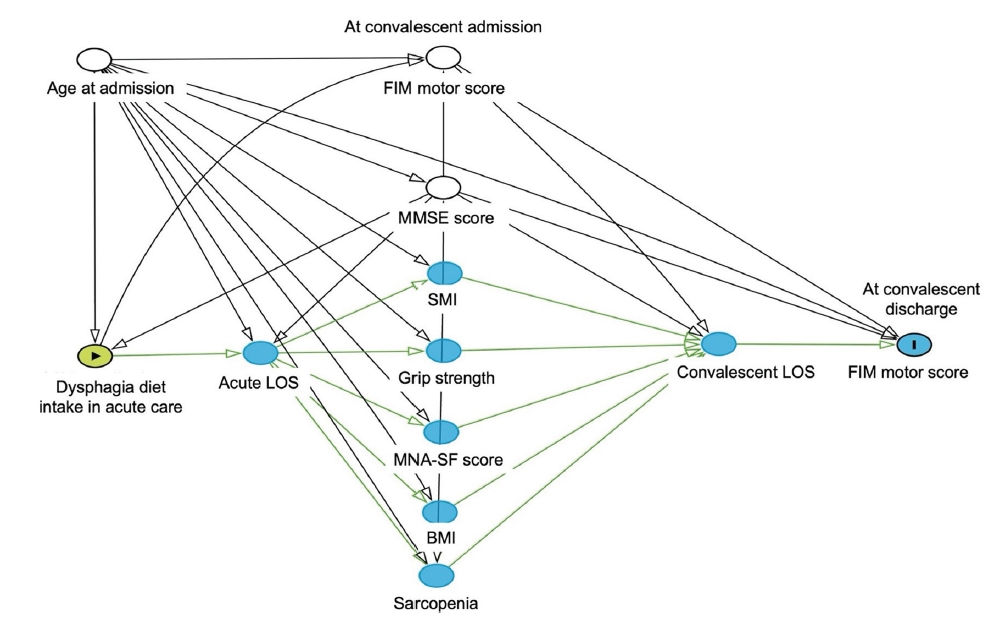
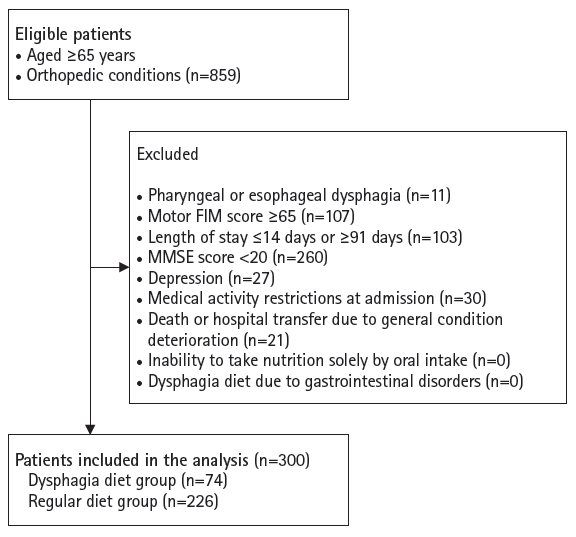
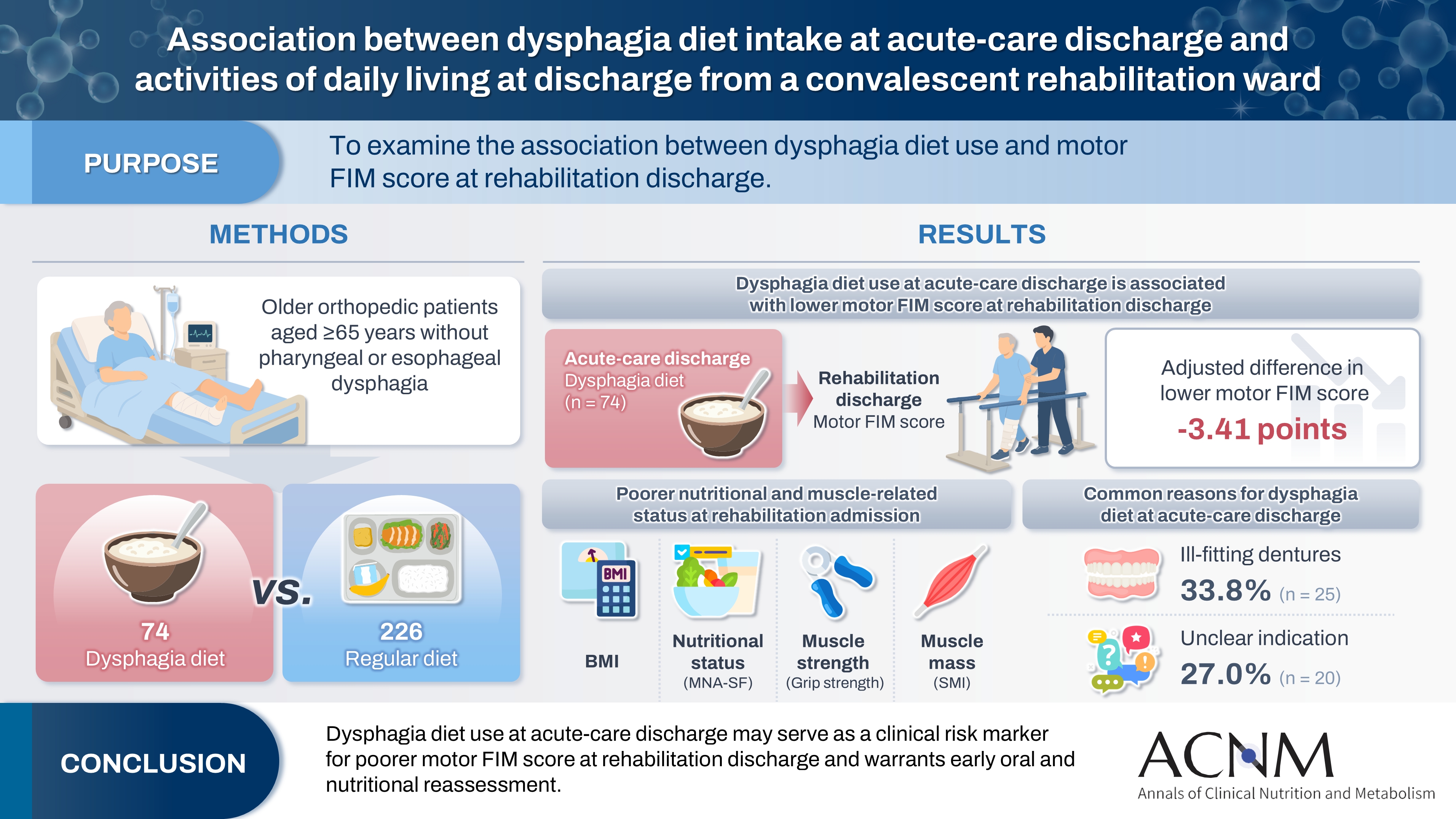
Fig. 1. Directed acyclic graph illustrating the presumed relationships among acute-care dysphagia diet intake, baseline characteristics, nutritional status, and functional outcome at discharge. FIM, Functional Independence Measure; MMSE, Mini-Mental State Examination; SMI, skeletal muscle mass index; MNA-SF, Mini Nutritional Assessment–Short Form; BMI, body mass index; LOS, length of stay.
Fig. 2. Flowchart of the patient selection process. A total of 859 eligible patients aged ≥65 years with orthopedic conditions were screened. After applying the exclusion criteria, 300 patients were included in the final analysis (74 in the dysphagia diet group and 226 in the regular diet group).
Graphical abstract
Fig. 1.
Fig. 2.
Graphical abstract
Association between dysphagia diet intake at acute-care discharge and activities of daily living at discharge from a convalescent rehabilitation ward: a single-center retrospective cohort study in Japan
| Variable | Overall (n=300) | Dysphagia diet group (n=74) | Regular diet group (n=226) | P-value |
|---|---|---|---|---|
| Age (yr) | 86.0 (81.0–89.0) | 88.0 (82.3–90.0) | 86.0 (81.0–89.0) | 0.034 |
| Sex | 0.874 | |||
| Male | 68 (22.7) | 16 (21.6) | 52 (23.0) | |
| Female | 232 (77.3) | 58 (78.4) | 174 (77.0) | |
| Disease | 0.842 | |||
| Hip fracture | 163 (54.3) | 41 (55.4) | 122 (54.0) | |
| Thoracic or lumbar fracture | 85 (28.3) | 22 (29.7) | 63 (27.9) | |
| Others | 52 (17.3) | 11 (14.9) | 41 (18.1) | |
| CCI (point) | 1.0 (0.0–1.0) | 1.0 (0.0–1.0) | 1.0 (0.0–1.0) | 0.799 |
| Acute care LOS (day) | 29.0 (21.0–40.0) | 31.5 (23.8–41.3) | 28.0 (20.0–39.0) | 0.086 |
| FIM motor score (point) | 48.5 (39.0–56.0) | 45.0 (36.3–53.8) | 49.0 (40.3–57.0) | 0.014 |
| MMSE score (point) | 26.0 (23.0–28.0) | 25.0 (23.0–28.0) | 26.0 (23.0–28.0) | 0.464 |
| Variable | Overall (n=300) | Dysphagia diet group (n=74) | Regular diet group (n=226) | P-value |
|---|---|---|---|---|
| BMI (kg/m²) | 20.10 (17.71–22.50) | 19.01 (17.07–21.59) | 20.55 (18.05–22.63) | 0.002 |
| MNA-SF score | 5.0 (3.0–7.0) | 4.0 (3.0–6.0) | 5.0 (4.0–7.0) | 0.019 |
| Grip strength (kg) | 16.30 (13.1–20.0) | 14.20 (12.20–18.80) | 16.50 (13.50–20.40) | 0.019 |
| SMI (kg/m²) | 5.60 (5.00–6.60) | 5.40 (4.75–6.10) | 5.70 (5.10–6.70) | 0.005 |
| Sarcopenia | 157 (58.1) | 45 (67.2) | 112 (55.2) | 0.089 |
| No. | β (95% CI) | P-value | |
|---|---|---|---|
| Dysphagia diet at acute-care discharge | 300 | –5.52 (–8.16 to ˗2.88) | <0.001 |
| Age | 300 | –0.30 (–0.47 to –0.12) | <0.001 |
| Sex | 300 | 1.10 (–1.69 to 3.90) | 0.440 |
| FIM motor score | 300 | 0.58 (0.49 to 0.66) | <0.001 |
| MMSE score | 300 | 1.14 (0.77 to 1.51) | <0.001 |
| SMI | 267 | 0.60 (–0.49 to 1.69) | 0.280 |
| Grip strength | 284 | 0.52 (0.32 to 0.73) | <0.001 |
| MNA-SF score | 300 | 0.52 (–0.07 to 1.11) | 0.086 |
| BMI | 299 | 0.07 (–0.26 to 0.39) | 0.690 |
| Sarcopenia | 270 | –1.18 (–3.71 to 1.35) | 0.360 |
| Acute care LOS | 249 | –0.07 (–0.14 to 0.01) | 0.086 |
| Model 1 (n=300) | Model 2 (n=300) | Model 3 (n=284) | Model 4 (n=284) | |||||
|---|---|---|---|---|---|---|---|---|
| β (95% CI) | P-value | β (95% CI) | P-value | β (95% CI) | P-value | β (95% CI) | P-value | |
| Dysphagia diet at acute-care discharge | –3.41 (–5.55 to –1.28) | 0.002 | –3.43 (–5.58 to –1.28) | 0.002 | –3.22 (–5.38 to –1.06) | 0.004 | –3.28 (–5.46 to –1.11) | 0.003 |
| Age | –0.10 (–0.24 to 0.04) | 0.140 | –0.10 (–0.24 to 0.04) | 0.145 | –0.10 (–0.25 to 0.04) | 0.171 | –0.10 (–0.25 to 0.05) | 0.180 |
| FIM motor score | 0.51 (0.42 to 0.60) | <0.001 | 0.51 (0.42 to 0.60) | <0.001 | 0.49 (0.40 to 0.59) | <0.001 | 0.49 (0.40 to 0.59) | <0.001 |
| MMSE score | 0.36 (0.02 to 0.69) | 0.040 | 0.36 (0.02 to 0.70) | 0.038 | 0.32 (–0.02 to 0.66) | 0.067 | 0.34 (–0.01 to 0.69) | 0.057 |
| MNA-SF score | NA | NA | –0.03 (–0.51 to 0.45) | 0.896 | NA | NA | –0.13 (–0.63 to 0.36) | 0.600 |
| Grip strength | NA | NA | NA | NA | 0.12 (–0.06 to 0.30) | 0.185 | 0.13 (–0.05 to 0.31) | 0.168 |
Table 1. Patient characteristics at admission to the convalescent ward
Values are presented as median (interquartile range) or number (%). CCI, Charlson Comorbidity Index; LOS, length of stay; FIM, Functional Independence Measure; MMSE, Mini-Mental State Examination. P<0.05 was considered statistically significant.
Table 2. Comparison of nutritional indices between groups at admission to the convalescent ward
Values are presented as median (interquartile range) or number (%). Data availability differed across variables due to missing data: BMI (n=299), MNA-SF (n=300), grip strength (n=284), SMI (n=267), sarcopenia (n=270). BMI, body mass index; MNA-SF, Mini Nutritional Assessment–Short Form; SMI, skeletal muscle mass index. P<0.05 was considered statistically significant.
Table 3. Univariable regression analyses for FIM motor score at discharge
FIM, Functional Independence Measure; β, unstandardized regression coefficient; CI, confidence interval; MMSE, Mini-Mental State Examination; SMI, skeletal muscle mass index; MNA-SF, Mini Nutritional Assessment–Short Form; BMI, body mass index; LOS, length of stay. P<0.05 was considered statistically significant.
Table 4. Multivariable regression models for FIM motor score at discharge
The models were adjusted as follows: Model 1: Adjusted for dysphagia diet, age, admission FIM motor score, and MMSE score; Model 2: Adjusted for the variables in Model 1 plus the MNA-SF score; Model 3: Adjusted for the variables in Model 1 plus grip strength; Model 4: Adjusted for all variables listed in the table. FIM, Functional Independence Measure; β, unstandardized regression coefficient; CI, confidence interval; MMSE, Mini-Mental State Examination; MNA-SF, Mini Nutritional Assessment–Short Form; NA, not applicable. P<0.05 was considered statistically significant.


