
 E-submission
 KSPEN
KSPEN KSSMN
KSSMN ASSMN
ASSMN JSSMN
JSSMNIndexed in:
Scopus, KCI, KoreaMed
Scopus, KCI, KoreaMed

Search
- Page Path
- HOME > Search
Case Report
- Metabolic deterioration in a patient with refractory status epilepticus complicated by refeeding syndrome: a case report
-
Manju Mathew
 , Karthiraj Natarajan
 - Ann Clin Nutr Metab 2026;18(2):181-186. Published online July 31, 2026
- DOI: https://doi.org/10.15747/ACNM.25.0042
-
 Abstract
 PDF
PDF - A 50-year-old moderately built woman with hypothyroidism presented with acute-onset headache, neck pain, vomiting, and transient confusion. She developed seizures in the emergency department requiring intubation. She was subsequently reintubated for refractory status epilepticus, requiring propofol infusion to achieve burst suppression. During her initial intensive care unit course, she had hypoalbuminemia and persistent hypokalemia. Following the initiation of enteral feeding and propofol infusion, she developed metabolic abnormalities suggestive of refeeding syndrome, including severe hypophosphatemia, feed intolerance, and glucose intolerance. A detailed dietary history suggested chronic malnutrition, possibly related to anorexia nervosa. She also exhibited features consistent with propofol infusion syndrome, including hypothermia, elevated lactate, and hemodynamic instability. The interplay between propofol use and refeeding syndrome appeared to trigger a cascade of complications, including worsening hypotension, hyperlactatemia, rhabdomyolysis, hepatic and renal failure, and ultimately fatal cardiac arrest. Refractory status epilepticus requiring propofol infusion, in the context of carbohydrate deprivation and critical illness, may have contributed to catastrophic metabolic deterioration. This case highlights the complexity of metabolic disturbances in critically ill patients and underscores the importance of considering multiple overlapping mechanisms when evaluating clinical deterioration in this setting.
- 570 View
- 12 Download

Original Article
- Association between the calcium-to-phosphorus ratio and early hypophosphatemia in preterm infants receiving parenteral nutrition in Korea: a retrospective cohort study
-
Miseon Han
 , Jin Ok Kyun, Yoong-A Suh, Jang Hoon Lee
 - Ann Clin Nutr Metab 2026;18(1):44-53. Published online March 30, 2026
- DOI: https://doi.org/10.15747/ACNM.25.0039
-
 Graphical Abstract
Abstract
PDF
Graphical Abstract
Abstract
PDF Supplementary Material
 - Purpose
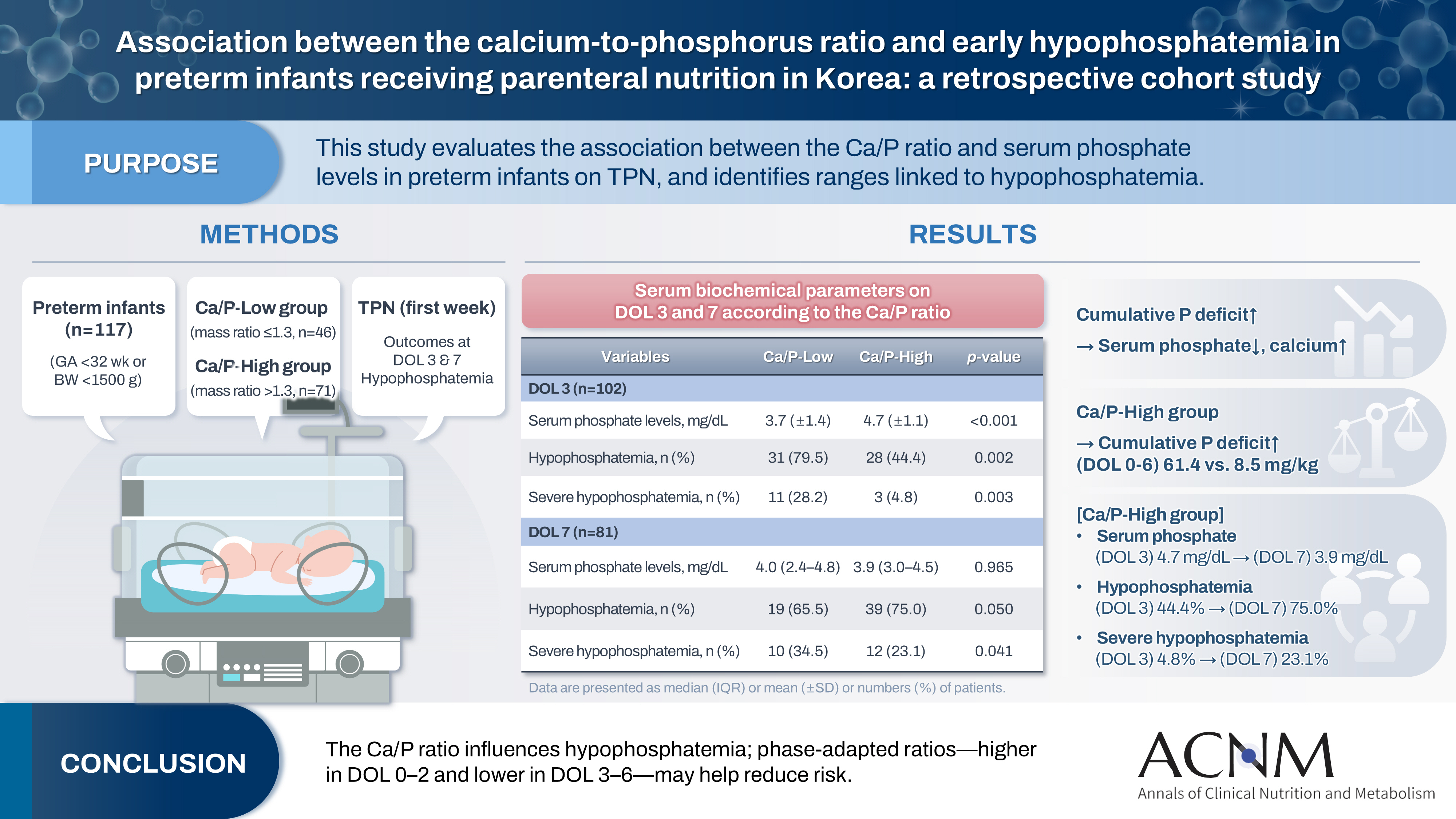
This study aimed to evaluate the association between the calcium-to-phosphorus (Ca/P) ratio and serum phosphate levels in preterm infants receiving total parenteral nutrition (TPN) and to explore Ca/P ratio ranges associated with hypophosphatemia.
Methods
We retrospectively reviewed the medical records of preterm infants admitted to the neonatal intensive care unit at Ajou University Hospital between January 2022 and June 2024. The review focused on TPN composition and serum electrolyte changes during the first week of life. Based on the cumulative Ca/P ratio during this period, infants were categorized into two groups: Ca/P-Low (mass ratio ≤1.3) and Ca/P-High (mass ratio >1.3).
Results
A total of 117 preterm infants were included in the analysis (Ca/P-Low group, n=46; Ca/P-High group, n=71). During the first week of life, the cumulative phosphorus deficit was significantly greater in the Ca/P-High group (61.4 mg/kg vs. 8.5 mg/kg; P<0.001). By day of life (DOL) 7, both hypophosphatemia and severe hypophosphatemia had increased markedly in the Ca/P-High group compared with DOL 3. In the Ca/P-High group, the incidence of hypophosphatemia increased from 44.4% on DOL 3 to 75.0% on DOL 7, while the incidence of severe hypophosphatemia increased from 4.8% to 23.1%.
Conclusion
These findings suggest that parenteral nutrition strategies may benefit from phase-adapted Ca/P ratios rather than a fixed ratio during the first week of life. A higher ratio may be considered during DOL 0–2, whereas a lower ratio may be considered during DOL 3–6, particularly when overall calcium and phosphorus supply is suboptimal.
- 2,621 View
- 38 Download
Case Report
- Refeeding Syndrome after Gastrectomy in a Patient with Hypophosphatemia: A Case Report
-
Cheong Ah Oh
- Ann Clin Nutr Metab 2022;14(2):88-92. Published online December 1, 2022
- DOI: https://doi.org/10.15747/ACNM.2022.14.2.88
-
Abstract
PDF
- This study describes an 81-year-old male who was highly suspicious for refeeding syndrome (RFS) after a retrospective review of his postoperative clinical progression. This highlights the importance of clinicians’ awareness of the possibility of RFS development in surgical patients with any RFS risk factors.
- 4,589 View
- 36 Download
 First
First Prev
Prev


